Rectifying Random Motion with Surface Microstructure
Roughness gradients, Feynman's ratchet, and engineering directionality from random vibration
Four years at the University of Washington answering one question: given random vibrational energy, can the surface itself bias that energy into directional droplet transport? Result: a Langmuir paper (400+ citations), the ratchet idea presented at Transducers 2007 and later expanded into an Advanced Materials cover article (2012), and the scaling-analysis-first method I would carry into every industrial program afterward.

The question that shaped the postdoc was deceptively simple: given random vibrational energy supplied to the substrate, can the surface itself bias that energy into directional droplet transport? Vibration is isotropic. The directionality has to come from the surface. I was at the University of Washington from 2003 to 2007, between the Department of Electrical Engineering and the Department of Bioengineering; the surface-physics work came out of the last two of those four years.
The Defining Work
Two mechanisms answered the question. The first was a roughness gradient: a droplet on a textured superhydrophobic surface sits in the Cassie–Baxter state, perched on the tops of pillars with air trapped beneath, and the apparent contact angle is set by the geometric area fraction in contact, not by bulk material chemistry. Grading the pillar pitch grades the apparent surface energy, and a droplet moves down the gradient.
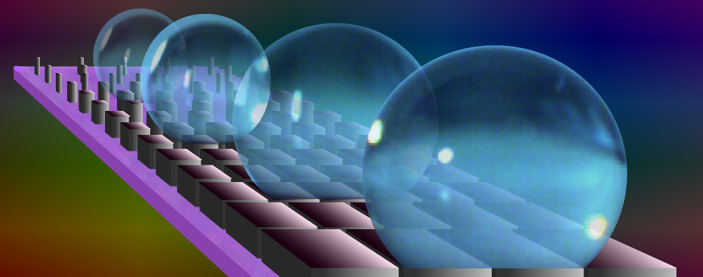
A gradient cannot close a loop, by a thermodynamic argument. So the second mechanism was Feynman’s ratchet: a periodic surface texture whose unit cell is asymmetric (pillars of graded dimension within the unit cell, repeated across the surface) has no global gradient, yet a preferred direction at every point. The vibration supplies the energy; the local asymmetry within each cell rectifies it into directional motion. What the gradient cannot do, the ratchet can: close a loop and drive cyclic transport indefinitely.
Outcome
Shastry, Case, Böhringer, Directing Droplets Using Microstructured Surfaces, Langmuir 22, 6161 (2006), cited 400+ times. The ratchet idea presented at Transducers 2007 (Shastry, Taylor, Böhringer, Micro-Structured Surface Ratchets for Droplet Transport, TRANSDUCERS, Lyon), establishing 2007 as the priority date for the invention. Later expanded as the cover article: Duncombe, Erdem, Shastry, Baskaran, Böhringer, Controlling Liquid Drops with Texture Ratchets, Advanced Materials 24, 1545 (2012). Two granted University of Washington patents (US 8,142,168 vibration-driven droplet transport; US 7,442,515 temperature-responsive surface chemistry). The scaling-analysis-first method became permanent industrial practice.
Read further
- Why I Love Inverse Problems
- Design Space Mapping in Multi-Physics Systems
- Innovation by Analogy is Dangerous
- From Academia’s Aha to Industry’s Reality Check
University of Washington, 2003–2007. Acknowledgments: Richard Feynman (the Brownian ratchet, Lectures on Physics Vol. 1, Ch. 46); Pierre-Gilles de Gennes (capillarity and wetting); David Quéré (introduction to superhydrophobicity; co-author with de Gennes on Capillarity and Wetting Phenomena: Drops, Bubbles, Pearls, Waves); L. Mahadevan (Harvard; soft-matter mechanics, sustained inspiration); Prof. Karl F. Böhringer (postdoc supervisor and co-inventor).